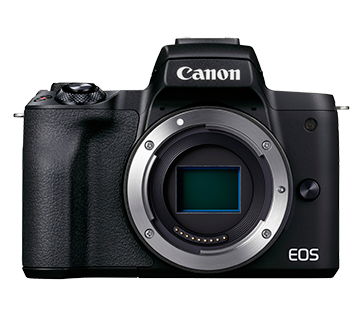
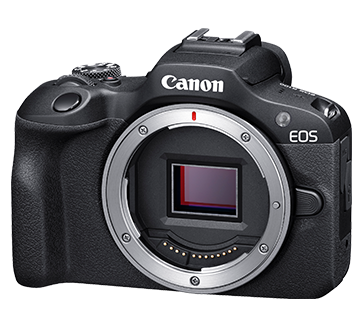
The Canon EOS M50 Mark II and the Canon EOS R100 are both entry-level mirrorless cameras designed for enthusiasts, beginners, and content creators looking to step up from smartphones or basic compacts. They are often compared because of their similar sensor sizes, nearly identical resolution, and approachable price points within Canon's mirrorless ecosystem. However, they differ in system compatibility-one uses the older EF-M mount, while the other leverages Canon's future-facing RF mount.
Buyers choosing between these two cameras primarily want a portable, affordable mirrorless body for photography and casual video. Key differentiators include autofocus system sophistication, lens ecosystem, ergonomics, and connectivity features tailored toward hybrid creators or straightforward photography.
While the EOS M50 Mark II offers features like a fully articulated touchscreen and a more mature interface for vlogging, the newer EOS R100 sets itself apart with RF mount compatibility, a more recent release date, and a refined form factor. The choice largely depends on the buyer's priorities-system investment, usability, and feature needs.
Specifications Comparison
Detailed Comparison
Image Quality
Both cameras feature similar APS-C-sized sensors with virtually identical effective areas (22.3 x 14.9 mm for the M50 Mark II and identical in the R100). Their resolutions are near-equal as well, at 24.1 megapixels for the M50 Mark II and 24 megapixels for the R100, yielding nearly indistinguishable image detail for real-world usage.
However, there are subtle differences in their ISO handling and processing pipelines. The EOS M50 Mark II offers a broader native ISO range (100 - 25,600 expandable), which theoretically provides more flexibility in low-light situations, while the R100 tops out at ISO 12,800. In most typical situations, both deliver clean images at moderate ISOs, but the M50 Mark II holds a slight edge for extreme low-light shooting.
Color reproduction, dynamic range, and RAW file flexibility are strong on both cameras-typical of Canon's APS-C sensors. Prospective buyers will not find a meaningful real-world difference in overall image quality under most conditions.
Autofocus System
The two cameras take notably different approaches to autofocus. The Canon EOS M50 Mark II features Canon's tried-and-true Dual Pixel AF system that offers reliable face and eye detection, especially useful for video and subject-tracking in stills. However, the R100, despite being newer, relies on a basic contrast-detection autofocus system with up to 143 points, which is less advanced in continuous tracking and eye detection features.
In practice, the M50 Mark II offers better and smoother subject acquisition and is noticeably more effective for live subjects-such as people, pets, and during video. The R100's AF, while serviceable for static subjects, is slower and less confident in demanding or changing scenarios, particularly in lower light or fast subjects.
For photographers interested in reliable, modern autofocus, especially for moving subjects or vlogging, the M50 Mark II remains ahead. The R100's AF system is acceptable for basic photography but not quite as sophisticated.
Video Capabilities
Video performance is a significant differentiator. The Canon EOS M50 Mark II is designed with content creators in mind, offering Full HD up to 60p and a fully articulated touchscreen that is ideal for vlogging and self-recording. Autofocus in video is quick thanks to Dual Pixel AF and real-time subject tracking, making it very easy for solo creators to stay in focus and compose shots.
The R100, in contrast, offers limited video features: it lacks the fully articulated screen and has a more basic autofocus system. Moreover, while it does support 4K recording, it does so with a significant crop and much slower contrast-detect AF, making it less desirable for serious video work. There's also no microphone input, further limiting its appeal for creators interested in improving audio quality.
For hybrid shooters and vloggers, the M50 Mark II is the clear winner, offering a more comprehensive and flexible video feature set. The R100 serves as a "photography-first" camera with basic video capability rather than an all-round hybrid.
Build & Ergonomics
The Canon EOS R100 is lighter and more compact, weighing just 356 grams and measuring 116 x 86 x 69 mm, making it exceptionally portable-perfect for travel or casual everyday use. Its RF mount design also adds future-proofing as Canon continues to invest in this lens line.
In contrast, the M50 Mark II is slightly larger and heavier but provides a more substantial grip and a fully articulated touchscreen-enhancing comfort for extended handheld shooting and offering more flexible shooting angles. The M50 Mark II's controls are slightly more advanced for users coming from DSLR-like ergonomics.
While the R100's lightness and compactness will appeal to minimalists or as a second camera, the M50 Mark II's ergonomics, particularly with its vari-angle screen and grip, provide better usability for creators and advanced users. Both bodies are solidly built for their class.
Battery & Storage
Battery life between the two cameras is fairly similar, with both delivering adequate performance for a day's casual shooting. The M50 Mark II uses the LP-E12 battery, and the R100 uses the LP-E17, but in real-world mixed use, the differentiation is marginal.
Both cameras use standard SD card storage, supporting UHS-I speeds that are sufficient for basic photo and moderate video workloads. Neither offers dual card slots or advanced battery options, but both are reliable for everyday usage.
Given their comparable performance in power and storage, neither stands out as a clear winner here. Both will require spare batteries for intensive outings or video, but meet expectations for entry-level models.
Value for Money
The Canon EOS R100 is positioned as one of the most affordable RF-mount bodies, debuting at around $480 in the US, which is very competitive for a new-generation Canon camera. Its entry-point price and access to the growing RF lens ecosystem represent strong value for those seeking an affordable path into Canon's current system.
The M50 Mark II, while sometimes available at discounts due to its older age, typically costs slightly more depending on market or kit configuration. However, it offers significantly more video and autofocus features for the price-which some users will see as superior value, especially if video is important.
Overall, for pure photography on a budget and those wishing to invest in the RF lens roadmap, the R100's pricing is attractive. For hybrid shooters seeking more features for creative work today, the M50 Mark II's richer suite justifies its price.
Lens Ecosystem
The lens ecosystem is a critical buying consideration. The M50 Mark II uses Canon's EF-M mount, which is mature but limited in choice and may no longer see new releases as Canon shifts focus to RF. Adaptation to EF DSLR lenses is possible but can add bulk.
The R100, employing Canon's RF mount, grants access to modern RF and RF-S lenses. While the native APS-C lens lineup is still growing, it is Canon's current and future mount-meaning more options, better long-term support, and consistent updates. Full-frame RF glass can also be used, offering an upgrade path.
For users seeking to expand or future-proof their system, the R100 and RF mount offer stronger potential. For those content with a fixed selection of EF-M lenses or adapting, the M50 Mark II is still viable, but with limited long-term growth.
Our Verdict
In a direct head-to-head, the Canon EOS M50 Mark II emerges as the winner for most hybrid shooters and content creators due to its superior autofocus system, fully articulated screen, stronger video features, and slightly broader ISO range. It is the better all-rounder for users who want reliable autofocus for both stills and video, and who need creative flexibility out of the box. However, the Canon EOS R100 is a compelling choice for entry-level photographers prioritizing affordability, portability, and access to the growing RF lens system. If your focus is primarily photography, you don't require advanced video features, and you wish to future-proof your camera system investment, the R100 is a strong contender-particularly as the most accessible gateway to Canon's RF mount. Ultimately, the M50 Mark II holds the edge overall for its feature set at this price point, especially for content creators and vloggers, but the R100 is unbeatable in value for those who want Canon's latest mount in a simple, modern package.
Canon EOS M50 Mark II
Canon EOS R100
Also Compare
Frequently Asked Questions
Which camera is better for video and vlogging: Canon EOS M50 Mark II or Canon EOS R100?
The Canon EOS M50 Mark II is much better suited for video and vlogging, thanks to its fully articulated touchscreen, superior Dual Pixel autofocus during video recording, microphone input, and ease of self-recording. The R100's basic autofocus, lack of flip screen, and limited controls make it less ideal for content creators.
Can I use the same lenses on both cameras?
No, the M50 Mark II uses EF-M mount lenses, while the R100 supports Canon's RF and RF-S lenses. Adapters can be used for certain lens types, but the two systems are not natively compatible. The RF mount (R100) is Canon's current and future lens system, while EF-M's growth is likely limited.
Is there a significant difference in image quality between the two?
In practice, both cameras deliver nearly identical image quality because they share similar APS-C sensors with 24-megapixel resolution. Minor differences in ISO range and processing exist, but for everyday use, image quality is a tie.
Which camera has better autofocus for moving subjects?
The M50 Mark II is equipped with Canon's Dual Pixel autofocus, offering more reliable and faster subject tracking, face and eye detection, especially in continuous (servo) AF. The R100 uses a less advanced contrast-detect system, which is slower and less accurate for moving subjects.
Which camera should I pick if I want to expand my lens collection in the future?
The R100, with the RF mount, is the better choice for users planning to grow their lens collection and future-proof their system. The RF system continues to receive new lenses, while EF-M options are limited and unlikely to expand further.
Is the R100's lightweight and compact body noticeably better for travel?
If size and weight are top priorities, the R100's compact, lightweight body makes it slightly more convenient for travel and everyday carry. However, the difference is modest, and the M50 Mark II is still very portable.